
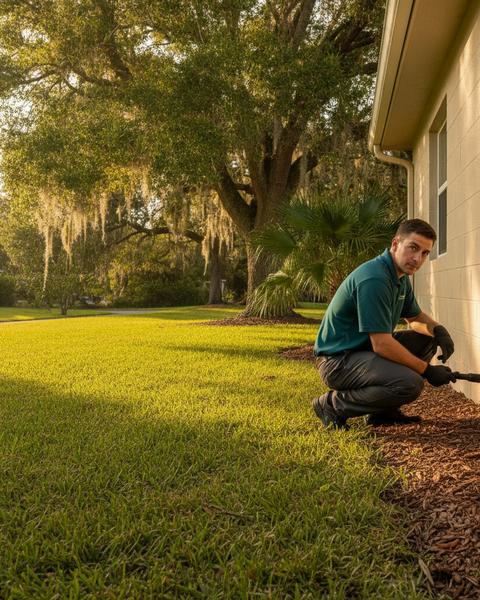
Persons depicted are actors or models.
Pensacola & Escambia County
Termite Control for Pensacola Homes
Northwest Florida sits in the heaviest termite pressure band in the continental United States. If you have found mud tubes, discarded wings or a soft spot in the trim, the colony is already in contact with your house.
(850) 788-4305Calls answered 24 hours a day, 7 days a week · Homes and apartments across the Pensacola area
The reason termites are a different problem here
Most pest problems are an annoyance. This one is structural, and Northwest Florida has some of the highest termite pressure in the country. Warm soil year-round, high moisture, sandy soils that drain and reheat quickly, and a long-established Formosan termite presence along the Gulf Coast all stack in the same direction.
There is no dormant season here that gives your house a break. In a northern state, soil temperature drops far enough that subterranean termite foraging slows dramatically for months. On the Gulf Coast the soil rarely gets cold enough for long enough, so foraging continues through most of the year.
Damage here accumulates on a faster clock than the national averages you will read online. A problem that would take years to become visible in Ohio can become visible in a fraction of that time in Escambia County.
Get an inspection scheduled
Describe what you found and where. We will connect you with a local pest control provider.
Call (850) 788-4305The signs, in the order people usually notice them
- Discarded wings. Small piles of identical translucent wings on a windowsill, in a bathtub, in a light fixture or along a door track, usually in spring or early summer.
- Mud tubes. Pencil-width tubes of packed soil running up a block foundation, a pier, a slab edge or the inside of a crawlspace. They can also appear inside a garage on the wall behind stored boxes.
- Hollow or soft trim. Baseboard, door casing or window sill that gives under a thumbnail, or sounds hollow when tapped. Termites eat wood from the inside and leave a thin surface layer intact.
- Blistered or rippled paint. Often mistaken for water damage. On an interior wall with no plumbing behind it, it is worth a closer look.
- Sticking doors and windows. Sometimes just Gulf Coast humidity. Sometimes structural members losing section.
- A swarm indoors. Dozens of dark-winged insects around a light on a warm evening. This is the sign people call about most, and it means a mature colony is nearby.
Why store-shelf termite products cannot solve this
The retail termite aisle sells stakes, foams and sprays. None of them are doing what a professional treatment does, and the reason is geometry, not chemistry.
A colony is not where the damage is. Subterranean termite workers forage through soil, sometimes well over a hundred feet from the nest. Treating the board they chewed does not touch the colony that sent them, and the colony simply routes around the treated area.
A treated zone has to be continuous to matter. Professional liquid treatments aim to establish an unbroken treated band in the soil around and under the structure, including at every plumbing penetration, expansion joint and porch slab. A homeowner cannot trench and rod a full perimeter with a garden sprayer, and a gap of a few inches is a doorway.
Bait systems work by transfer, over time. Modern termite baiting relies on workers carrying a growth-inhibiting material back and sharing it through the colony. That requires correct station placement, monitoring on a schedule and enough patience to let the colony decline. It is a program, not a purchase.
Formosan colonies can nest above ground. When there is enough moisture inside a wall, a Formosan colony can establish a carton nest inside the structure and stop depending on soil contact at all. Soil treatment alone can miss that entirely, which is why species identification changes the plan.
Do not wait on this one
Termite damage is cumulative and it does not pause. Call and get an inspection on the calendar.
Call (850) 788-4305What a provider will want to know when you call
Have this ready and the call will be short and useful:
- What you found and exactly where — wings on a sill, tubes on the north foundation wall, soft baseboard in the guest bathroom
- When you first noticed it
- Your construction type — slab on grade, crawlspace, or piers; block or frame
- Whether the home has been treated before, and roughly when
- Whether you kept a sample — a few insects or wings in a jar makes species identification much faster
Save anything you collected. Do not spray the swarmers with a household aerosol before someone looks at them; a mangled sample is harder to identify, and killing the swarmers you can see has no effect on the colony.
Related problems in the same walls
Moisture is the common denominator for most Gulf Coast structural pests. If you also have ants trailing along the same baseboard, it is worth mentioning on the call, because some ants nest in the exact water-damaged wood termites prefer and the two get confused constantly. Damp crawlspaces and mulch beds that support termites also support centipedes and millipedes and earwigs.
Questions homeowners ask
Termite Control in Pensacola — the short answers
I found a pile of wings on the windowsill. Is that termites?
Very likely. Swarming termites shed their wings almost immediately after landing, so a small pile of identical translucent wings near a window, door track or light fixture is a classic sign. Ant wings are unequal in length, front pair longer; termite wings are all four the same length. Keep a few of the wings and any insects in a bag or a jar so the provider can identify the species, because the species changes the treatment.
What is the difference between a subterranean and a Formosan termite?
Formosan termites are a subterranean termite, but an unusually aggressive one. Their colonies can be an order of magnitude larger than a native subterranean colony, they can build satellite nests above ground inside a wall, and they cause damage faster. Northwest Florida has established Formosan populations, which is one reason local pressure is higher than the national picture.
Are those hard mud tubes on my block wall a problem?
Mud tubes are shelter tubes termites build to cross exposed surfaces while staying in a humid, sealed environment. Finding them on a foundation, pier or slab edge means workers are travelling between the soil and your structure. Do not knock them all down before the inspection; leaving them intact helps the provider read the direction and the activity level.
When is termite swarm season in Pensacola?
Native subterranean termites typically swarm in the spring, often on a warm day after rain. Formosan swarms in the Gulf Coast region usually run later, in the warmer evenings of late spring into early summer, and they are strongly attracted to lights. Seeing a swarm does not mean the colony started this year; colonies generally have to mature for several years before they produce swarmers.
Can I treat termites myself with something from the store?
You can treat the termites you can see. That is the problem. The colony is in the soil or inside a wall void, often many feet from where you found the damage, and retail products do not establish a continuous treated zone around a structure or deliver a transferable material back to the colony. Spot-treating the visible damage usually just relocates the visible activity.
How much damage is already done?
Nobody can answer that from the outside. It requires an inspection by the provider, and that is the most important thing to get on the calendar. Termites work quietly inside wood for a long time before anything shows on the surface, so what is visible is generally the tail end of the problem, not the start of it.
Also common in Pensacola homes
Other pests we help homeowners with
Cockroach Control
German roaches in the kitchen, smokybrowns from the attic and the palms. Why baits stall out here.
Ant Control
Argentine, ghost, fire and carpenter ants — four different problems that all look like a trail on the counter.
Spider Control
Webs in the eaves and garage, plus the two species worth taking seriously here.
Rodent Control (Mice & Rats)
Roof rats in attics, house mice in kitchens, and why trapping alone never ends it.
Cricket Control
Camel crickets in the garage and the field crickets that pile up under exterior lights.
Silverfish & Clothes Moths
Humidity-driven pests that eat paper, starch and natural fibres in closets and storage.
Earwig Control
The pincer bug that shows up after rain. A moisture and mulch-line problem more than an indoor one.
Centipedes & Millipedes
Post-rain millipede migrations and the fast centipedes that follow the same moisture indoors.
Ready to stop patching the problem?
Tell us what you are seeing in your home and we will connect you with a local pest control provider.
Call (850) 788-4305See the Pensacola-area communities we cover · About Pensacola Pest Control