
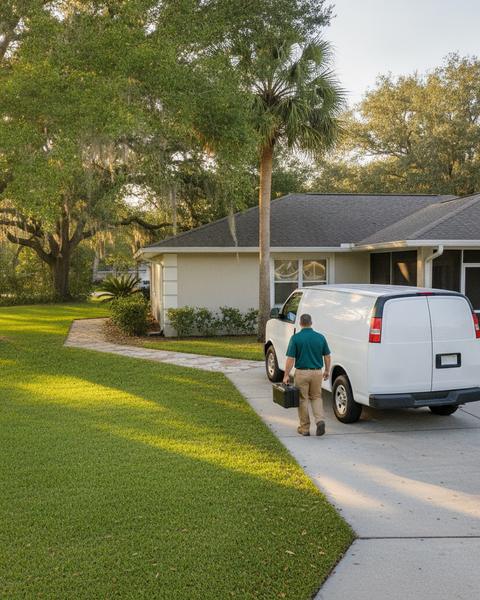
Persons depicted are actors or models.
Pensacola & Escambia County
Mouse & Rat Control for Pensacola Homes
Scratching in the ceiling at dusk, droppings behind the toaster, a chewed corner in the pantry. Trapping the ones inside is the easy half. The half that decides whether it comes back is finding how they got in.
(850) 788-4305Calls answered 24 hours a day, 7 days a week · Homes and apartments across the Pensacola area
Roof rats own the Pensacola attic
If you are hearing activity overhead in an Escambia County home, roof rats are the first suspect. Coastal Florida is their preferred habitat, and the local landscape hands them a highway: live oaks and pines with limbs over the roof, fence lines, utility runs, and dense palm and shrub cover against the wall.
They enter high. That is the single most useful thing to know, because homeowners spend weeks setting traps at floor level in a kitchen while the actual route is a two-inch gap where the soffit returns meet the fascia.
House mice are the other half of the problem and behave differently: ground-level entry, short travel range, and a strong preference for staying within about twenty feet of a food source. That is why mouse activity concentrates in pantries, under ranges and behind dishwashers.
Traps remove the animals currently inside. They do nothing about the opening that let them in. In a neighbourhood with established rodent pressure — which describes most established Pensacola-area streets with mature trees — an unsealed entry gets used again within weeks. Exclusion is the part that determines whether you are done.
Tell us where you are hearing it
Attic, wall, under the kitchen cabinets. Time of day matters too.
Call (850) 788-4305What a provider does that a trap line does not
- Inspection for entry points, on the roof line and at ground level — soffit returns, gable vents, ridge vents, plumbing stacks, dryer and bath vents, garage door corners, utility penetrations
- Exclusion work — sealing those openings with materials rodents cannot gnaw through, which is the step that actually ends the cycle
- Correct trap placement along runways and against vertical surfaces, in the numbers required, rather than a few traps in the open
- Controlled use of bait stations where appropriate, placed and secured so pets and non-target animals cannot reach them
- Sanitation guidance for contaminated insulation and droppings, which is a health matter and not a DIY sweep-up
Signs worth calling about
- Scratching or scurrying overhead at dusk or before dawn
- Droppings behind appliances, in a pantry, along an attic joist, or in a garage
- Gnaw marks on food packaging, plastic bins, wire insulation or a wooden door edge
- Greasy dark rub marks along a baseboard, joist or pipe run
- A sudden strong odor in one part of the house with no obvious cause
- A pet fixated on one spot of wall or ceiling
Rodents and cockroaches frequently share the same entry points and the same moisture conditions, so it is worth mentioning both if you are seeing both.
Questions homeowners ask
Rodent Control (Mice & Rats) in Pensacola — the short answers
I hear it in the ceiling, not the walls. What does that mean?
Ceiling and attic noise around dusk and dawn is the signature of roof rats, which are the dominant rat in coastal Florida. They are excellent climbers and travel on power lines, fences and overhanging branches, so they typically enter high — soffit gaps, roof-line junctions, gable vents, and around plumbing stacks — rather than at ground level.
I set traps and caught several, then nothing. Is it over?
Usually not. Catching the bold individuals first is normal, and the remaining animals become trap-shy quickly. More importantly, if the entry points are still open the space simply gets recolonised. A catch count is not a resolution.
How small a gap can they use?
A house mouse can pass a gap around a quarter inch — roughly a pencil width. A roof rat needs about half an inch. That means gaps you would never think to look at count: a lifted soffit corner, the annular gap around a cable penetration, an unsealed dryer vent, a gap at the garage door corner where the seal has flattened.
Is it safe to just use poison bait outside?
This is worth a conversation with the provider rather than a purchase. Rodenticide used casually creates two real problems: animals dying inside a wall void or attic, which becomes an odor and fly problem for weeks, and secondary exposure risk for pets and non-target animals. Placement, product choice and tamper-resistant stations are exactly the part homeowners get wrong.
What is the actual risk, beyond the noise?
Rodents gnaw continuously because their incisors keep growing, and electrical wiring in an attic is a common target. They also contaminate insulation and stored food and can carry parasites. In an attic the insulation damage alone often costs more than the rodent work.
How do I know it is rats and not something larger?
Rats and mice are light, fast and most active around dusk and dawn. If what you are hearing is noticeably heavier, moves around in the middle of the day, or sounds like something being dragged across the ceiling, that is a different kind of animal and a different kind of specialist. This site covers mice and rats in homes and apartments.
Also common in Pensacola homes
Other pests we help homeowners with
Cockroach Control
German roaches in the kitchen, smokybrowns from the attic and the palms. Why baits stall out here.
Termite Control
Subterranean and Formosan termites, swarm season, mud tubes and why spot treatment misses the colony.
Ant Control
Argentine, ghost, fire and carpenter ants — four different problems that all look like a trail on the counter.
Spider Control
Webs in the eaves and garage, plus the two species worth taking seriously here.
Cricket Control
Camel crickets in the garage and the field crickets that pile up under exterior lights.
Silverfish & Clothes Moths
Humidity-driven pests that eat paper, starch and natural fibres in closets and storage.
Earwig Control
The pincer bug that shows up after rain. A moisture and mulch-line problem more than an indoor one.
Centipedes & Millipedes
Post-rain millipede migrations and the fast centipedes that follow the same moisture indoors.
Ready to stop patching the problem?
Tell us what you are seeing in your home and we will connect you with a local pest control provider.
Call (850) 788-4305See the Pensacola-area communities we cover · About Pensacola Pest Control