
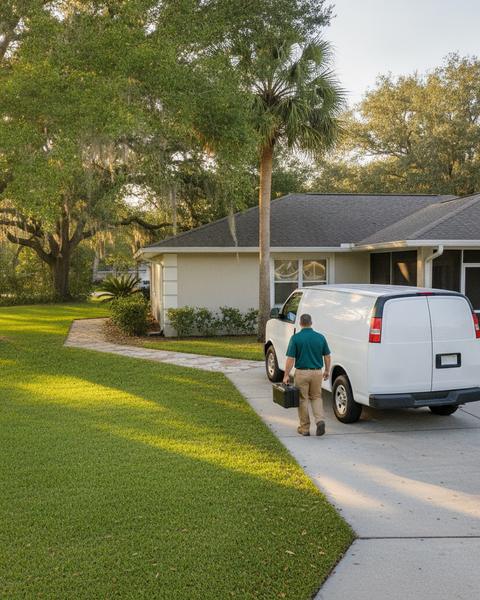
Persons depicted are actors or models.
Pensacola & Escambia County
Centipede & Millipede Control for Pensacola Homes
Millipedes arrive by the hundreds after rain and die on the patio. Centipedes arrive one at a time and move alarmingly fast across a bathroom floor. Same underlying cause, different experience.
(850) 788-4305Calls answered 24 hours a day, 7 days a week · Homes and apartments across the Pensacola area
Both are moisture animals
Neither of these belongs indoors and neither can survive there long. They live in the damp organic layer against your house — mulch, leaf litter, under pavers and stones, under the deck, in the top inch of soil. Pensacola keeps that layer wet for most of the year, and the heavy summer rain pattern regularly pushes them out of it.
Millipedes move in bulk. After a saturating rain, or during a dry stretch when they are looking for moisture, they migrate in large numbers, cross patios and driveways, gather at garage doors and threshold gaps, and come in under the door. Indoors they dehydrate and die, which is why the usual complaint is sweeping up dozens of curled bodies for several days running.
Centipedes come in one or two at a time and stay if there is something to eat. They are predators, so an ongoing indoor centipede presence is a tell that something else — silverfish, small roaches, ants — is established in the same space.
A millipede wave is a weather and landscaping event: the band against your house is saturated and your thresholds are open. A recurring centipede is a food-chain event: something they eat is living in your walls or storage. The second one is worth investigating further.
Hundreds at once, or one at a time?
That distinction tells a provider which problem you actually have.
Call (850) 788-4305What a provider does
- Treats the exterior harborage band — the mulch line, the slab edge, under the deck, and the shaded damp side of the house where the population concentrates
- Handles the entry points — door sweeps, garage door bottom and corner seals, thresholds, weep screens, utility penetrations, crawlspace vents
- Reads the moisture conditions — grading, downspout discharge, irrigation schedule, mulch depth, crawlspace ventilation
- Looks for the prey base when centipedes are recurring indoors, because clearing the food is what clears them
Before the call
Note whether it is a wave or a trickle, whether it follows rain, and which side of the house they are entering. That is genuinely diagnostic and saves time on the phone.
The same conditions produce earwigs and crickets, and if centipedes are hunting indoors it is worth checking for silverfish and cockroaches at the same time.
Questions homeowners ask
Centipedes & Millipedes in Pensacola — the short answers
What is the difference between them?
Millipedes are slow, cylindrical, dark, and curl into a tight spiral when disturbed. They have two pairs of legs per body segment and they eat decaying plant matter. Centipedes are flattened, faster, tan to brown, with one pair of legs per segment and a visible pair of forcipules at the head. Centipedes are predators; they are hunting the other insects in your house.
Do centipedes bite?
The large ones can, and it is genuinely painful for most people, with local swelling. It is not medically serious for most adults but it is not nothing. The small house centipedes with the very long legs rarely break skin at all.
Why did hundreds of millipedes appear overnight?
Millipede migrations are a real seasonal phenomenon, usually triggered by heavy rain saturating the soil or by a dry spell driving them to seek moisture. They travel in numbers, they cannot survive indoors for long, and they typically die within a day or two of coming inside. The volume is the complaint, not the damage.
Do they damage the house or the plants?
Millipedes do not damage structures and are mostly beneficial decomposers outdoors, though large numbers can graze seedlings. Centipedes damage nothing at all. The reason to deal with either is nuisance and, for centipedes, what their presence indicates.
If centipedes eat other bugs, is having them a good thing?
It is a useful signal rather than a benefit. Centipedes stay where prey is available, so a persistent indoor centipede population means there is a persistent indoor insect population feeding it — often silverfish, cockroaches or ants you have not noticed yet. Worth mentioning on the call.
What actually keeps them out?
Drying the band against the house and closing the low entries. Mulch pulled back off the foundation, leaf litter cleared, downspouts discharging away from the slab, irrigation dialled back, door sweeps and garage seals replaced, and weep screens intact.
Also common in Pensacola homes
Other pests we help homeowners with
Cockroach Control
German roaches in the kitchen, smokybrowns from the attic and the palms. Why baits stall out here.
Termite Control
Subterranean and Formosan termites, swarm season, mud tubes and why spot treatment misses the colony.
Ant Control
Argentine, ghost, fire and carpenter ants — four different problems that all look like a trail on the counter.
Spider Control
Webs in the eaves and garage, plus the two species worth taking seriously here.
Rodent Control (Mice & Rats)
Roof rats in attics, house mice in kitchens, and why trapping alone never ends it.
Cricket Control
Camel crickets in the garage and the field crickets that pile up under exterior lights.
Silverfish & Clothes Moths
Humidity-driven pests that eat paper, starch and natural fibres in closets and storage.
Earwig Control
The pincer bug that shows up after rain. A moisture and mulch-line problem more than an indoor one.
Ready to stop patching the problem?
Tell us what you are seeing in your home and we will connect you with a local pest control provider.
Call (850) 788-4305See the Pensacola-area communities we cover · About Pensacola Pest Control