
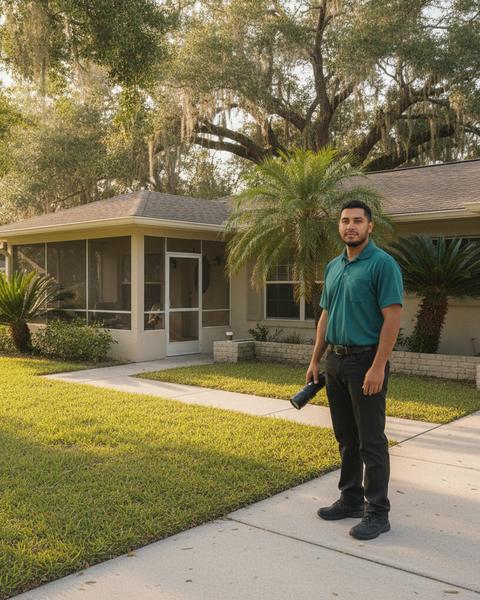
Persons depicted are actors or models.
Pensacola & Escambia County
Cockroach Control for Pensacola Homes
If you have already been through the gel baits, the foggers and the sprays and they are still coming out at night, the problem is not your effort. It is where the roaches actually live.
(850) 788-4305Calls answered 24 hours a day, 7 days a week · Homes and apartments across the Pensacola area
Why the store products stopped working
Almost everyone calling about roaches in Pensacola has already spent money at the hardware store. Usually in this order: a spray, then a fogger, then gel bait, then more gel bait. There is a good reason that sequence fails, and it is worth understanding before you spend another weekend on it.
German cockroaches breed faster than a hardware-store product can kill them. One female produces an egg case holding roughly 30 to 40 eggs, and she can produce several of those in her life. The egg case itself, the ootheca, is a hardened capsule that most contact insecticides simply do not penetrate. So you kill the adults you can see, feel like you won, and three weeks later a fresh generation walks out of the same wall void.
Repellent sprays make the problem move rather than end. Most consumer aerosols are repellent by design. Roaches detect the treated band and go around it, which pushes the population deeper into the structure and out along shared walls. In a duplex or an apartment, that is how a one-room problem becomes a building problem.
Bait rotation matters, and you cannot do it with one product. Populations in long-running infestations develop bait aversion, where they simply stop eating a formulation they have been exposed to for months. Professionals rotate active ingredients and bait matrices for exactly this reason. A homeowner buying the same tube of gel from the same shelf is, by definition, not rotating anything.
If you are seeing roaches during the day, finding egg cases, or smelling that musty odor in a cabinet, the population is well past what a retail product is designed for. That is not a failure of effort. Those products are built for the two roaches that wandered in, not for an established indoor breeding population.
Talk to someone about what you are actually seeing
Describe the roach, the room and how long it has been going on. We will connect you with a local pest control provider.
Call (850) 788-4305What makes Pensacola different
Escambia County sits in a humid subtropical band where the average relative humidity rarely drops far enough to make life hard on a cockroach. Three local conditions do most of the damage:
- Year-round warmth. There is no hard winter here to knock populations back. In colder states, outdoor roach pressure collapses for months. On the Gulf Coast it just slows down, then rebounds with the first warm rain.
- Slab-on-grade construction and block walls. A large share of Pensacola-area homes are built on concrete slab with concrete block exterior walls. The expansion joints, plumbing penetrations and the hollow cells inside block are ideal harborage, and they connect the exterior to the interior in ways a wood-frame house does not.
- Heavy mulch, palms and live oaks. Smokybrown cockroaches breed outdoors in leaf litter, palm boots and tree hollows, then come in through weep holes, soffit gaps and around utility penetrations. This is why people with an immaculate kitchen still find a three-inch roach in the bathtub. That roach did not come from your kitchen.
The two roaches you are most likely fighting
German cockroach (Blattella germanica) — small, tan, two dark stripes. Lives indoors permanently, concentrated within about ten feet of food and water. This is the kitchen and bathroom roach, the one that multiplies, and the one that actually requires a treatment plan rather than a product.
Smokybrown cockroach (Periplaneta fuliginosa) — large, uniformly dark mahogany, a strong flier. Lives outdoors in mulch beds, palm fronds and attics, and comes inside when it is dry, when it rains hard, or when it simply finds a gap. Treatment for this one is mostly about the exterior and the entry points, which is why indoor gel bait does nothing for it.
What a provider actually does differently
The gap between a retail approach and a professional one is not a stronger chemical. It is inspection and placement.
- Finding the harborage. Voids, appliance motor housings, cabinet corners, the hollow under a countertop overhang. Treatment goes where the roaches sit, not where you saw one run.
- Non-repellent materials. Products roaches cannot detect, so they walk through the deposit and carry it back into the harborage instead of avoiding a treated line.
- Growth regulators. Materials that stop nymphs from reaching breeding age, which is what actually breaks the generational cycle the egg cases keep restarting.
- Exterior work for the outdoor species. Mulch line, weep holes, soffits, and the palms and oaks that are producing smokybrowns in the first place.
- Follow-up on a schedule tied to the hatch cycle, not tied to when you happen to remember.
Get a local provider on the phone
One call, no forms. Tell them what room, what size, and how long.
Call (850) 788-4305When it is worth calling
Call if any of these are true, because each one means the population is established rather than incidental:
- You see roaches in daylight, or more than one at a time
- You have found egg cases, small dark capsules with ridged sides, in cabinet corners or behind appliances
- There is a musty, oily odor in a cabinet or under the sink
- You are in an apartment or duplex and a neighbor has the same problem
- You have treated two or more times with retail products and it keeps coming back
Ants often show up in the same kitchens for the same moisture reasons — see ant control if you are dealing with both. If you are finding large numbers of one dark insect in the garage and around the doors at night, it may be crickets rather than roaches.
Questions homeowners ask
Cockroach Control in Pensacola — the short answers
Why do I only see roaches at night?
Both of the species that dominate here are nocturnal and thigmotactic, which means they want to feel surfaces pressed against their bodies. During the day they wedge into voids you cannot reach: behind the fridge motor, inside the dishwasher frame, under the sink lip, inside the hollow of a hollow-core door. Seeing one in daylight usually means the harborage is crowded.
Is a German cockroach different from the big ones I see outside?
Very. German cockroaches are small, tan, with two dark stripes behind the head, and they live their entire lives indoors, breeding continuously. Smokybrown and American cockroaches are the large ones that fly in from the mulch, palms and sewer lines. They need completely different treatment strategies, which is a common reason a store product that worked on one does nothing to the other.
I used a fogger and it got worse. What happened?
Total-release foggers push repellent aerosol into the room, not into the voids where roaches sit. The usual result is that the population scatters deeper into wall voids and into adjacent rooms or units, which spreads the infestation instead of reducing it. Most professionals will tell you a fogger is the single most counterproductive thing you can buy.
How long does it take to clear a German cockroach problem?
Ask the provider on the call, because it depends on how long it has been building and on the construction of your home. A single treatment rarely finishes it; the egg cases are protected and have to hatch into treated surfaces. Expect a plan measured in weeks, with follow-up, not a single visit.
Do I have to throw out my food and empty my kitchen?
Ask the provider what preparation they want. Different treatment approaches require very different prep, and doing the wrong prep, like deep-cleaning every surface right before a bait treatment, can actually reduce how well it works.
Do you cover apartments and rentals?
Yes. Apartments, houses and family homes across the Pensacola area are all covered. If you rent, it is worth knowing which walls you share, because in multi-unit buildings roaches move along shared plumbing and electrical runs.
Also common in Pensacola homes
Other pests we help homeowners with
Termite Control
Subterranean and Formosan termites, swarm season, mud tubes and why spot treatment misses the colony.
Ant Control
Argentine, ghost, fire and carpenter ants — four different problems that all look like a trail on the counter.
Spider Control
Webs in the eaves and garage, plus the two species worth taking seriously here.
Rodent Control (Mice & Rats)
Roof rats in attics, house mice in kitchens, and why trapping alone never ends it.
Cricket Control
Camel crickets in the garage and the field crickets that pile up under exterior lights.
Silverfish & Clothes Moths
Humidity-driven pests that eat paper, starch and natural fibres in closets and storage.
Earwig Control
The pincer bug that shows up after rain. A moisture and mulch-line problem more than an indoor one.
Centipedes & Millipedes
Post-rain millipede migrations and the fast centipedes that follow the same moisture indoors.
Ready to stop patching the problem?
Tell us what you are seeing in your home and we will connect you with a local pest control provider.
Call (850) 788-4305See the Pensacola-area communities we cover · About Pensacola Pest Control